
visarunway.app
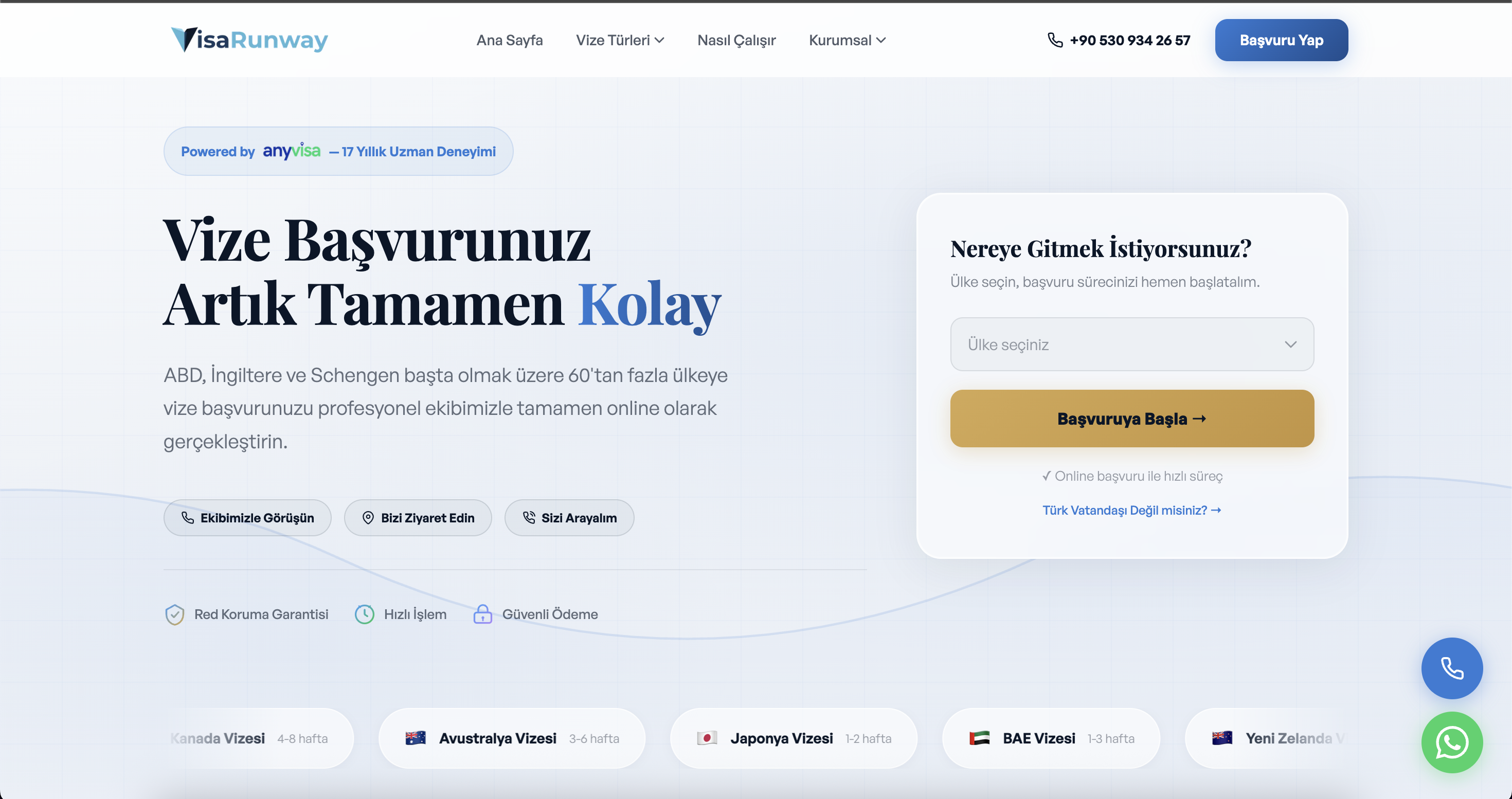
Visarunway
Fast-growing visa agency scaling with technology
0→2K
monthly applications in year one
60%
reduction in support inquiries
48h
from kickoff to first live application
Most fee disputes in a visa agency start with a quote that shows one number. Here is how to split government fees, visa centre charges and your own fee, state the refund rules, and handle currency.

Show each charge on its own line: the government visa fee, any visa application centre charges, other official charges, and your agency's service fee. For each line, say who receives the money, who sets the amount, whether it is refundable, and what currency applies. The client should be able to see exactly which part is yours.
That sounds obvious. In practice, many agencies still send a single total on WhatsApp: "Schengen visa, all inclusive, X." The client pays, the visa is refused, and then the argument starts. The client thinks the whole amount was the agency's fee and asks for it back. The agency knows most of it went to the consulate and the visa centre and cannot be recovered. Neither side is lying. The quote just never made the split clear.
This article is about the quote itself: the document the client sees before paying. It does not cover how to set your prices. For that, read Pricing Strategies for Visa Consulting Services and How to Price Visa Services Across Different Markets. The distinction underneath all of this is explained in the glossary entry on government fee vs service fee.
A clear quote does three jobs:
When a client asks "how much is the visa?", they usually mean the total amount they will pay. That total is made of several separate charges. Each one goes to a different party and follows different rules. The table below lists the common ones. Not every destination uses all of them.
| Fee component | Paid to | Refundable? | Who sets it |
|---|---|---|---|
| Visa application fee | The consulate or immigration authority | Usually not, once the application has been considered | The government |
| Visa centre service fee | The external service provider running the centre | Depends on the provider's terms | The provider, within limits set by the government |
| Optional centre extras (premium lounge, courier, SMS) | The external service provider | Depends on the provider's terms | The provider |
| Other official charges (for example a health surcharge or issuance fee) | The government | Depends on the charge | The government |
| Agency service fee | Your agency | Set by your own refund policy | You |
| Third-party costs (translation, courier, insurance) | The supplier | Set by the supplier | The supplier |
Some of these charges have their own rules. In the US, the machine-readable visa fee (see MRV fee) is the main application charge. The UK charges an Immigration Health Surcharge on some applications, with its own refund rules. For Schengen visas, EU law also limits the fee charged by a visa application centre. Under Article 17 of the EU Visa Code, that service fee may not be more than half of the standard visa fee, apart from some exceptions for countries where the member state has no consulate.
Governments change fee amounts, so do not keep them in a fixed price list. At the time of writing (September 2026), the European Commission lists the standard Schengen visa fee as €90 for adults and €45 for children aged 6 to 12. Check the current amount before every quote.
Book a quick demo and see how it works for your visa types.
This is the part of the quote that causes most disputes. It is also where official rules are clearest. The general rule is that the government charges for considering the application, not for granting a visa. A refusal therefore does not bring the money back. Details differ by destination:
| Destination | What the official rule says | Where to check |
|---|---|---|
| Schengen states | The visa fee is not refundable, except where the application is inadmissible or the consulate is not competent to handle it (Visa Code Article 16) | EU Visa Code, Articles 16, 18 and 19 |
| United Kingdom | The application fee is usually not refunded once fingerprints and photo have been given. It is refunded if the client withdraws before that. A refused visa leads to a full health surcharge refund | GOV.UK refund and IHS guidance |
| United States | The Department of State does not refund visa application fees, and the fee cannot be transferred to another applicant. The fee receipt can be used for 365 days from the date of purchase | The official US visa appointment service fee page |
Sources: EU Visa Code Article 16, GOV.UK: cancel your application and get a refund, GOV.UK: IHS refunds, and the US visa fee information page.
These rules shape what your quote should say. For each line, write the refund position in plain words:
Your own service fee is the only line where you choose the refund rule. The fairest approach links the refund to the work already done. For example, the consultation and document review are earned when completed, the application preparation is earned when it is submitted, and anything not yet started is refunded. Write the stages down in the quote. A policy that says "no refunds under any circumstances" usually just moves the argument to a card chargeback.
The refund rules above apply whatever the reason for a refusal. What your agency can influence, such as document quality, is covered in Visa Refusal Reasons: What Your Agency Can Actually Control.
Governments set fees in their own currency. They collect them in whatever currency they choose. The EU Visa Code, for example, says the Schengen visa fee is charged in euro, in the national currency of the country where the application is lodged, or in the currency usually used there (Article 16). The official US fee page lists visa fees in US dollars. Your client may pay you in a third currency.
That means any converted amount is an estimate on the day you write it. A quote that treats it as a fixed price will end up wrong. These practices keep it honest:
Point 5 matters more than it looks. If a client later sees the official fee on the consulate website and your "visa fee" line is higher, they will assume you inflated it. A separate handling line with a clear name avoids that problem. How much to charge for your own work in each market is a pricing decision, and How to Price Visa Services Across Different Markets covers it in detail.
There are two common set-ups, and the quote should make clear which one you use.
The client pays the government fee, and often the visa centre fee, through the official channel. Your agency only invoices its own service fee. This is the cleanest arrangement. Your books only hold your own money, and the client gets an official receipt in their own name. The EU Visa Code, for example, requires that the applicant receives a receipt for the visa fee paid.
Some regulators prefer this arrangement. The UK Immigration Advice Authority's practice note on fees and accounts says clients should be encouraged to pay fees such as the Home Office application fee directly to the authorities. It accepts that there are exceptions, for example when a client has no bank account.
This can be necessary when the client has no card that the official portal accepts, or when you handle a group or corporate booking. If you do it:
The operations side, meaning online checkout, payment links and matching payments to applications, is covered in How do I collect visa payments online? and on the e-commerce and payments page. Whatever system you use, set up your service fee and each pass-through amount as separate checkout items, so the split in the quote appears again on the invoice. VisaCRM includes online payments as part of the agency's own branded platform, which keeps the quote, payment and application in one client record.

Use this outline as a starting point and adapt it to each destination and service. It is not a legal form.
The summary table in the quote can look like this, with your own figures filled in:
| Line | Amount | Paid to | Refund if refused |
|---|---|---|---|
| Visa fee (per applicant) | [official amount and currency] | Consulate | No, except as set by the authority |
| Visa centre service fee | [provider amount] | Visa centre provider | Provider terms |
| Agency service fee | [your fee] | Your agency | Stage-based, see policy |
| Translations (estimate) | [supplier quote] | Translator | Not once work is delivered |
Family and group quotes need extra care, because children often pay a different official fee. Put each applicant on their own line and give a family total at the end. The case-handling side is covered in Managing Family Visa Applications Efficiently.
Tell us what you need and we'll come back with a plan. Nothing to pay until it's delivered.
Get started →A good template still fails if it is delivered badly. These habits prevent most fee disputes:
It also helps to answer common fee questions before the client asks. A short page on your website or in your client portal that explains the difference between official and agency fees will save repeated WhatsApp messages. Repetitive questions add up quickly as volume grows: Visarunway went from 0 to 2,000 applications a month and cut repetitive enquiries by roughly 60%, and fee questions are among the most predictable ones to answer in advance.
Finally, keep your quote wording in one place. When every consultant writes their own version, clients hear different refund rules for the same service. A shared template, reviewed whenever an official fee or refund rule changes, is a small piece of work that prevents a lot of arguments. If you are standardising other procedures too, Writing Visa Agency SOPs That Survive Staff Turnover explains how to keep those documents current.
Usually not. Most authorities charge for considering the application, not for issuing the visa. Schengen states refund the fee only in narrow cases, such as an inadmissible application. The UK usually does not refund once fingerprints and photo are taken. The US Department of State does not refund visa application fees. Always check the destination's current official rules and say this in the quote.
The visa fee is the official charge set and collected by the government for processing the application. A visa service fee is charged by someone else for their work. That can be a visa application centre running appointments and document intake, or an agency preparing the file. A quote should show them as separate lines, with who receives each one.
Show the government fee at its official amount and charge for your own work separately. If you have real costs such as card processing or currency conversion, show them as a clearly named handling line. Clients can see official fees on government websites, and a higher "visa fee" line looks like overcharging even when your total is fair.
Show each official fee in the currency the authority sets it in, give your converted estimate, and state the date and source of the exchange rate. Give the quote a validity period and say that official fees are charged at the rate on the payment date. If an official fee changes before submission, the client pays the new amount.
Direct payment is usually cleaner. The client gets an official receipt, and the agency only handles its own fee. The UK Immigration Advice Authority encourages regulated advisers to have clients pay authorities directly where possible. If you do collect official fees, keep that money separate from your own income and pass official receipts to the client.
Rules, fees and processes change. We checked this article against the official sources below on 16 September 2026 — confirm anything time-sensitive with the source before you rely on it.
The patterns in this article are already deployed across these platforms. Different brands, different visa types — one engine underneath.
Practical guides that go deeper on running a modern visa business.