
rotavisa.app
RotaVisa
Premium visa consultancy for business travelers
98%
visa approval rate
40+
countries served
70%
reduction in document errors
There is no global immigration consultant licence. Here is what the regulators in Canada, the UK, Australia and New Zealand actually require, why the US works differently, and what that means for building an agency.

You become an immigration consultant by meeting the requirements of the regulator in the country whose immigration law you want to advise on: usually a prescribed qualification, an entry exam, character checks and registration on a public register. Canada, the UK, Australia and New Zealand license consultants; the United States does not.
That answer surprises people who expect a single certificate. There isn't one. A licence is tied to one country's immigration system, and it only authorises advice on that system. An adviser registered in the UK is not thereby authorised to advise on Canadian applications, and the reverse is also true.
Where you sit also matters less than people assume. Being based abroad does not automatically take you outside a regime, which is why agencies that advise on several destinations often need more than one registration, or a qualified partner in each market.
This guide is written for people planning a consultancy or hiring for one, not for applicants. It summarises each regulator's published pathway as at September 2026, links to the source, and stays consistent with our overview of who can give immigration advice for a fee. It is an orientation, not legal advice. Requirements change, sometimes quickly, so confirm every step on the regulator's own site before you enrol in anything.
The five systems agency owners ask about most look like this:
| Country | Regulator | Who can give advice for a fee | First step |
|---|---|---|---|
| Canada | College of Immigration and Citizenship Consultants | Licensed consultants, lawyers and Ontario paralegals in good standing, Quebec notaries | Enrol in the Queen's University Graduate Diploma in Immigration and Citizenship Law |
| United Kingdom | Immigration Advice Authority | IAA-registered advisers in registered organisations, plus exempt legal professionals | Build the experience required for your target level |
| Australia | OMARA | Registered migration agents and Australian legal practitioners | Complete a prescribed graduate qualification in migration law |
| New Zealand | Immigration Advisers Authority | Licensed advisers and exempt persons | Complete an approved qualification |
| United States | No consultant regulator | Attorneys and DOJ-accredited representatives of recognised organisations | Law school and bar admission, or work at a DOJ-recognised organisation |
The regulators have short names that are easy to confuse. The UK body is the Immigration Advice Authority, formerly the OISC. New Zealand's body is also abbreviated IAA, but it is the Immigration Advisers Authority. Australia's is OMARA. Canada's College licenses the RCIC designation.
Each of these regulators keeps a public register. Whatever your route, the register is what clients, universities and partners will check, so the aim is not a certificate on the wall but an entry on that list.
Book a quick demo and see how it works for your visa types.
In Canada, the Government of Canada lists three kinds of paid representative: immigration and citizenship consultants who are members of the College of Immigration and Citizenship Consultants, lawyers and notaries who are members of a provincial or territorial law society or the Chambre des notaires du Québec, and, in Ontario only, paralegals who are members of the Law Society of Ontario. It tells applicants not to use anyone who is not a member in good standing.
The consultant route runs through education, an exam and licensing:
The College licenses more than one class: the RCIC designation for general immigration and citizenship work, and a narrower international student adviser designation. Our RCIC glossary entry explains the difference in scope.
Two practical points for agency builders. The College's site is where the exam dates, fees and language rules live, and those details have changed in recent years, so read them directly rather than relying on a course provider's summary. And if licensed consultants work alongside unlicensed staff, the division of work between them needs to be real and visible on every file.
In the United Kingdom, the Immigration Advice Authority registers advisers at one of three levels, and the level decides what work you may take on. Its guidance, *IAA adviser registration explained*, sets out the structure.
| Level | What it covers | Experience the IAA expects |
|---|---|---|
| Level 1: Advice and Assistance | Straightforward applications such as entry clearance and permission to stay | At least three months full-time UK immigration advice, or six months of other advice work |
| Level 2: Casework | Level 1 work plus more complex and discretionary applications | At least 12 months full-time, including six months at Level 2 |
| Level 3: Advocacy and Representation | Specialist casework and representation before the tribunals | At least 18 months full-time, including six months at Level 3 |
Advisers also register in a category: immigration, asylum and protection, or judicial review case management. The registration steps look like this:
Solicitors, barristers and other professionals regulated by an approved legal regulator do not need IAA registration. Everyone else who gives immigration advice or services in the course of a business does, and doing it unregistered is a criminal offence, as our glossary entry notes. The IAA also warns that having a solicitor or barrister review your work does not satisfy the requirements unless you work within a firm regulated by the Solicitors Regulation Authority or the Bar Standards Board.
The level structure matters for hiring. A Level 1 adviser cannot simply take on a complex case because the agency is busy, so plan your team's levels around the work you actually sell.

In Australia, OMARA says only registered migration agents, legal practitioners or exempt persons can lawfully give immigration assistance. It also names education agents specifically: an education agent who is not a registered migration agent or legal practitioner must not give immigration assistance. That line matters to every study-abroad agency sending students to Australia.
OMARA's published steps to register include:
At the time of writing (September 2026), OMARA lists the general initial application fee as AUD 1,760, and it cannot refund a fee if you apply in the wrong category. Check the current fee on OMARA's site before applying.
Lawyers have been outside OMARA's scheme since a 2021 reform. OMARA's current guidance says a legal practitioner holding an Australian practising certificate can provide immigration assistance in connection with legal practice, and that complaints about lawyers go to state and territory legal regulators rather than to OMARA.
There is also a trans-Tasman shortcut: under the Trans-Tasman Mutual Recognition Act 1997, OMARA recognises a licence from New Zealand's Immigration Advisers Authority, subject to the same limits as the New Zealand licence.
New Zealand regulates immigration advice through the Immigration Advisers Authority under the Immigration Advisers Licensing Act 2007. The IAA warns that there are significant penalties for people who provide New Zealand immigration advice without a licence or exemption.
The IAA describes three licence types. A provisional licence allows advice on all immigration matters under the supervision of a full licence holder. A limited licence covers only certain matters. A full licence covers all immigration matters. First-time advisers hold a provisional licence for two years under supervision before they can move to a full licence.
To qualify, applicants must meet the Immigration Adviser Competency Standards 2016. According to the IAA, these require:
The IAA publishes its list of approved qualifications on its site; check it before enrolling, because only an approved course counts. Registered Australian migration agents have a separate route under the Trans-Tasman Mutual Recognition Act 1997.
Some people, such as lawyers, can be exempt from licensing. The exemptions are narrow, so an education or travel agency advising on New Zealand visas should confirm its position with the IAA rather than assume one applies. The supervised provisional period also shapes hiring: a newly licensed adviser needs a fully licensed colleague to supervise them for their first two years.
Not in the sense the other countries use. The United States has no licence for a commercial, non-lawyer immigration consultant.
USCIS lists who may represent someone before it: attorneys licensed and in good standing in the US, foreign attorneys in limited circumstances, accredited representatives working for organisations on the Department of Justice's recognised list, and law students or graduates under supervision. People outside those categories may give limited help filling out forms, but they cannot represent the applicant or give legal advice, and USCIS says they can only charge a nominal fee. It encourages people to check their state's rules too.
The accredited representative route is not an individual licence. USCIS describes these representatives as accredited under the Department of Justice's Executive Office for Immigration Review and working for an organisation on the DOJ's list of recognised organisations. Accreditation is tied to that organisation, so it is not something a commercial agency owner can hold independently.
USCIS also warns specifically about "notarios". In several countries a notario público is a lawyer with special credentials; in the US a notary public is not an attorney and cannot represent anyone in an immigration case. Agencies serving US-bound clients should never use the word in their marketing.
In practice, then, the US options are:
Tell us what you need and we'll come back with a plan. Nothing to pay until it's delivered.
Get started →Most people searching for immigration consultant certification are really asking how to build a business that can sell immigration help lawfully. There are three workable models.
Whichever model you pick, write down where advice ends and administration begins, train every client-facing person on that line, and verify the register entry of every partner you refer to. Our guide to starting a visa consulting business covers the rest of the setup, and the visa consultant use case shows how the operational side is usually organised.
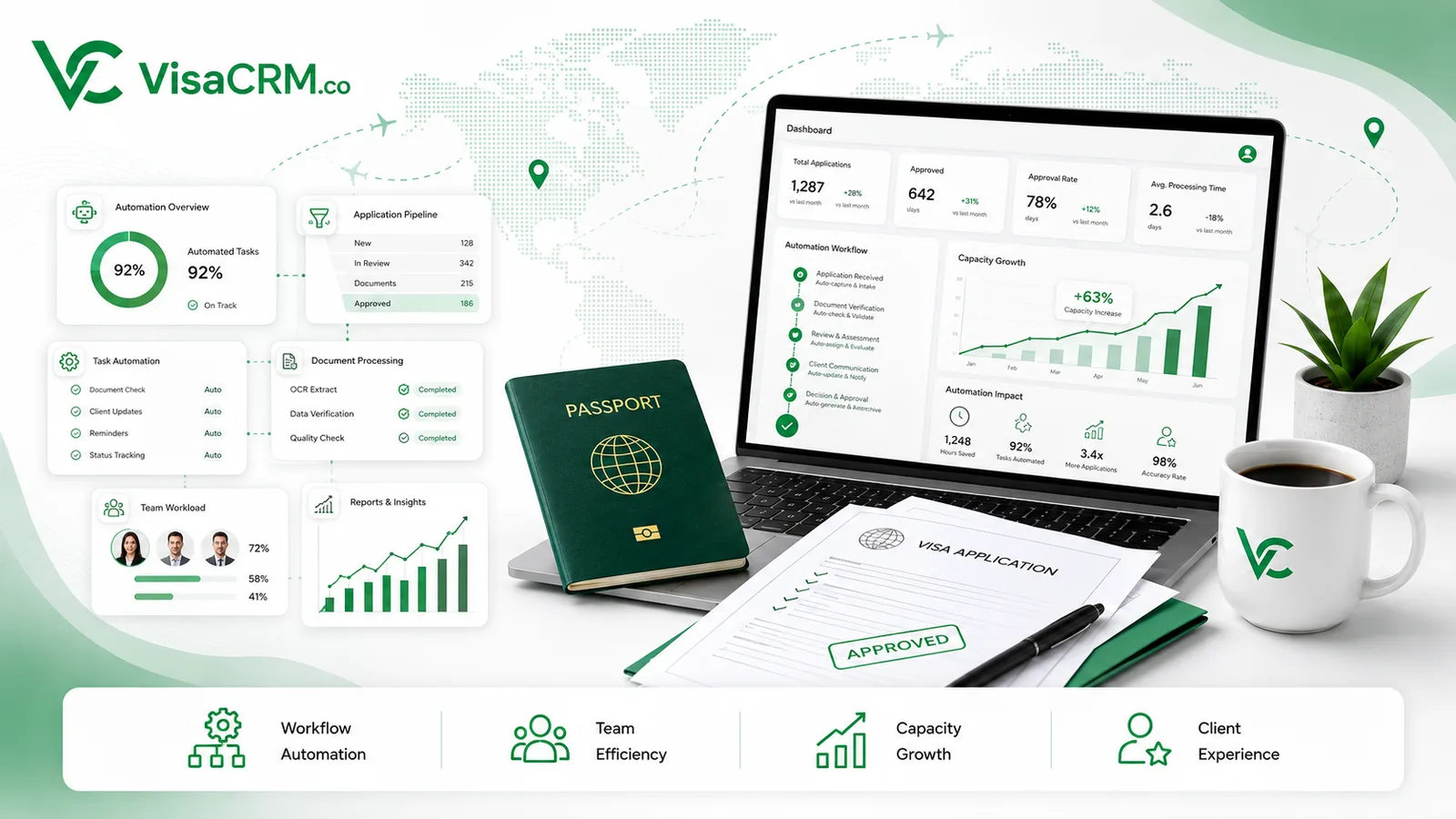
Software sits downstream of all of this. VisaCRM runs applications, documents, payments, client communication and a partner portal for an agency on its own brand, and it records who did what on each file, which helps a licensed adviser evidence supervision. It does not license anyone, give immigration advice or fill in government forms. Law firms use operational tools in the same way, as the immigration lawyers use case explains.
Get the licence question right first. Then choose the tools that let you run the practice cleanly. RotaVisa, which handles applications across more than 40 countries, is one example of a multi-country operation run this way; the RotaVisa case study shows the operational side.
No. Immigration advice is licensed country by country, and a licence authorises advice only on that country's immigration system. Canada, the UK, Australia and New Zealand each run their own regulator and register, and the United States has no consultant licence at all. Private courses may issue certificates, but none of them replaces registration with the relevant regulator.
The main fixed element is the Queen's University Graduate Diploma in Immigration and Citizenship Law, which Queen's says full-time students complete in under a year and part-time students in under two. After that you must pass the College's Entry-to-Practice Exam and complete its licensing requirements, so the overall timeline depends on exam dates and the College's current process.
Only if you are exempt, for example as a solicitor or barrister regulated by an approved legal regulator. Otherwise, providing immigration advice or services in the course of a business requires IAA registration at the right level and category, and doing it unregistered is a criminal offence. Advisers must also work within an IAA-registered organisation.
Not unless they are also a registered migration agent or an Australian legal practitioner. OMARA says an education agent who is neither must not give immigration assistance, because doing so is unlawful. Education agents can help students choose courses, but advice about the visa itself belongs with a registered agent or lawyer, whose status can be checked on the public register.
Not as a licensed adviser. USCIS allows representation only by attorneys, accredited representatives of DOJ-recognised organisations and a few supervised categories. Other people may give limited help filling out forms for a nominal fee, but cannot give legal advice or represent the applicant, and state rules add further limits. Calling yourself a notario is a well-known warning sign.
Rules, fees and processes change. We checked this article against the official sources below on 16 September 2026 — confirm anything time-sensitive with the source before you rely on it.
The patterns in this article are already deployed across these platforms. Different brands, different visa types — one engine underneath.
Practical guides that go deeper on running a modern visa business.