
rotavisa.app
RotaVisa
Premium visa consultancy for business travelers
98%
visa approval rate
40+
countries served
70%
reduction in document errors
One master checklist, adapted per visa type and per destination, prevents most missing-document delays. Here is a reusable structure for visitor, student, work and family cases.

Most visa applications need four groups of documents: proof of identity, proof of the purpose of the trip, proof of enough money, and proof of your situation at home or your status in the destination. The exact list depends on the visa type and the destination, so agencies keep a master checklist and adapt it to each official checklist.
The four layers are a useful way to think because they match what decision makers assess. The European Commission's page on applying for a Schengen visa lists a valid passport, an application form, a photo, medical insurance, and supporting documents about the purpose of stay, financial means, accommodation and intention to return. The UK's guide to supporting documents for visitors asks visitors to show a permitted activity, that they will leave, that they can support themselves, and that they can pay for the return journey.
For an agency, the layers look like this:
This article gives a generic template for each visa type. It is not a replacement for the destination's own list. Always check the official checklist for the country, the visa and the place of application before you send a list to a client.
Start with the core documents that almost every case needs, then add a module for each visa type, then a destination layer on top. This keeps one source of truth for the common parts and stops every consultant from keeping a private list.
The core module looks like this:
| Document | Why it is needed | Common mistake |
|---|---|---|
| Valid passport | Proves identity and nationality | Validity too short for the destination's rule |
| Previous passports | Show travel history | Old passports left at home and not scanned |
| Photos | Required by the form or the application centre | Wrong size or background for the destination |
| Application form | The legal application | Answers differ from supporting documents |
| Residence permit | Shows the right to apply from a third country | Expired or expiring during the trip |
| Translations | Make foreign documents readable | Missing translator details |
Passport validity is a good example of why the destination layer matters. The European Commission says a Schengen passport should be valid for at least three months after the date of departure from the Schengen area. Other destinations use different rules, so the rule belongs in the destination layer, not in the core module.
Translations also need a rule per destination. The UK guide for visitors says any document not in English or Welsh must have a full translation that the Home Office can verify, and each translation must include the translator's confirmation of accuracy, the date, the translator's full name and signature, and contact details. Put those points into the checklist, not only the word translation.
Build the checklist once and store it where cases are created. Our article on reducing document errors explains how to add a review step on top.
Book a quick demo and see how it works for your visa types.
Visitor cases look simple and fail for simple reasons: a purpose that is not clear, money that does not match the trip, or weak evidence of return. The generic module below follows the four layers.
| Document | Why it is needed | Common mistake |
|---|---|---|
| Travel plan or itinerary | Shows the purpose and length of the trip | Dates differ from the form |
| Accommodation evidence | Shows where the client will stay | Booking cancelled after the application |
| Invitation letter | Explains a visit to family, friends or a business | No details of the host's status |
| Bank statements | Show enough funds for the trip | Large unexplained deposits |
| Employment or study letter | Shows ties to home | No salary, role or leave dates |
| Sponsor evidence | Shows who pays if not the client | No proof of the sponsor's funds or relationship |
| Travel medical insurance | Required for some destinations | Cover too low or wrong dates |
The UK guide is specific about money: financial documents must clearly show access to the funds, and bank statements should show the origin of the funds held. If a sponsor pays, the UK asks for evidence of what support is given, how, the sponsor's own funds, the relationship, and the sponsor's legal status if they are in the UK. Children need a document showing the relationship to a parent, and a signed consent letter if they travel without a parent.
For Schengen, the Commission lists medical insurance covering emergency care, hospital treatment and repatriation, and notes that consulates may request additional documents. That is why the Schengen layer should be copied from the consulate or visa centre where the client applies.
See how agencies run these cases on our tourist visa, Schengen visa and UK visitor visa pages.
Student cases have one document that everything depends on: the enrolment document issued by the school. In the UK it is the Confirmation of Acceptance for Studies. In the US, the school issues Form I-20, and the Study in the States guide says students are expected to bring the original to the visa interview.
The UK Student visa documents page lists a current passport and a CAS, and says students may also need proof of money for the course and living costs, an ATAS certificate if the course and nationality require it, tuberculosis test results, parental consent and proof of relationship if under 18, and written consent from a financial sponsor who paid fees and living costs in the last 12 months.
| Document | Why it is needed | Common mistake |
|---|---|---|
| Enrolment document | Proves a confirmed place | Details differ from the passport |
| Academic records | Support the admission decision | Missing transcripts or unverified copies |
| English test result | Shows language level where required | Test expired or wrong test type |
| Financial evidence | Shows course fees and living costs are covered | Funds not held for the required period |
| Sponsor consent | Needed if a sponsor paid recently | Letter missing when a scholarship exists |
| Parental consent | Needed for minors | Consent from one parent only without sole responsibility |
| Health documents | TB test or medical where required | Test from a clinic not approved for the destination |
The financial row is where most agencies need the destination layer. Amounts and holding periods change and differ by destination, so link the current official rule in the case rather than writing a figure into your template. For how agencies handle volume in intake months, see our student visa solution.
Work cases start with the employer. Most work routes need a document from a licensed or approved employer, and the rest of the checklist is built around the job.
The UK Skilled Worker documents page lists the certificate of sponsorship reference number, proof of English, a valid passport, the job title and annual salary, the occupation code, and the employer's name and sponsor licence number. Depending on the case, applicants may also need evidence of savings, proof of relationship for family members, TB test results, a criminal record certificate for certain jobs, an ATAS certificate, or an Ecctis reference for an overseas PhD.
| Document | Why it is needed | Common mistake |
|---|---|---|
| Employer sponsorship document | Links the job to a licensed employer | Job details differ from the offer letter |
| Job offer or contract | Shows role, salary and start date | Salary or hours not matching the sponsorship |
| Qualifications | Prove the skills the job needs | Foreign degree not assessed where required |
| English evidence | Required on many work routes | Test or degree not accepted for the route |
| Criminal record certificate | Needed for some sectors | Certificate from only one country of residence |
| Savings evidence | Needed unless the employer certifies support | Balance dips below the level during the period |
| Family documents | For dependants applying together | Marriage or birth certificates not translated |
The UK page shows why a sector check belongs in the checklist: a criminal record certificate is needed for jobs in education, healthcare, therapy and social services when applying from outside the UK. Ask the job questions at intake, not at submission:
For employer-led cases, see our work permit and UK work visa pages.
Family cases carry the most documents and the most personal ones. They usually need proof of the relationship, proof of the sponsor's status, and proof that the family can support itself.
The UK partner and spouse page is a clear example. Applicants must prove the relationship, a good knowledge of English and the financial requirement. Relationship evidence should come from the government, a bank, a landlord, a utility provider or a medical professional, confirm the relationship, and be less than four years old. Fiancé applicants must show that any previous marriages or civil partnerships have ended.
| Document | Why it is needed | Common mistake |
|---|---|---|
| Marriage or partnership certificate | Proves a legal relationship | Not translated or not recognised |
| Cohabitation evidence | Proves living together | Documents older than the destination allows |
| Divorce or death certificates | Prove earlier relationships ended | Missing for one partner |
| Birth certificates | Prove parent and child links | Names differ from passports |
| Sponsor's status | Proves the sponsor's right to live there | Expired permit copy |
| Financial evidence | Shows the family meets the money rule | Wrong type of income for the route |
| English evidence | Required on some routes | Test not on the approved list |
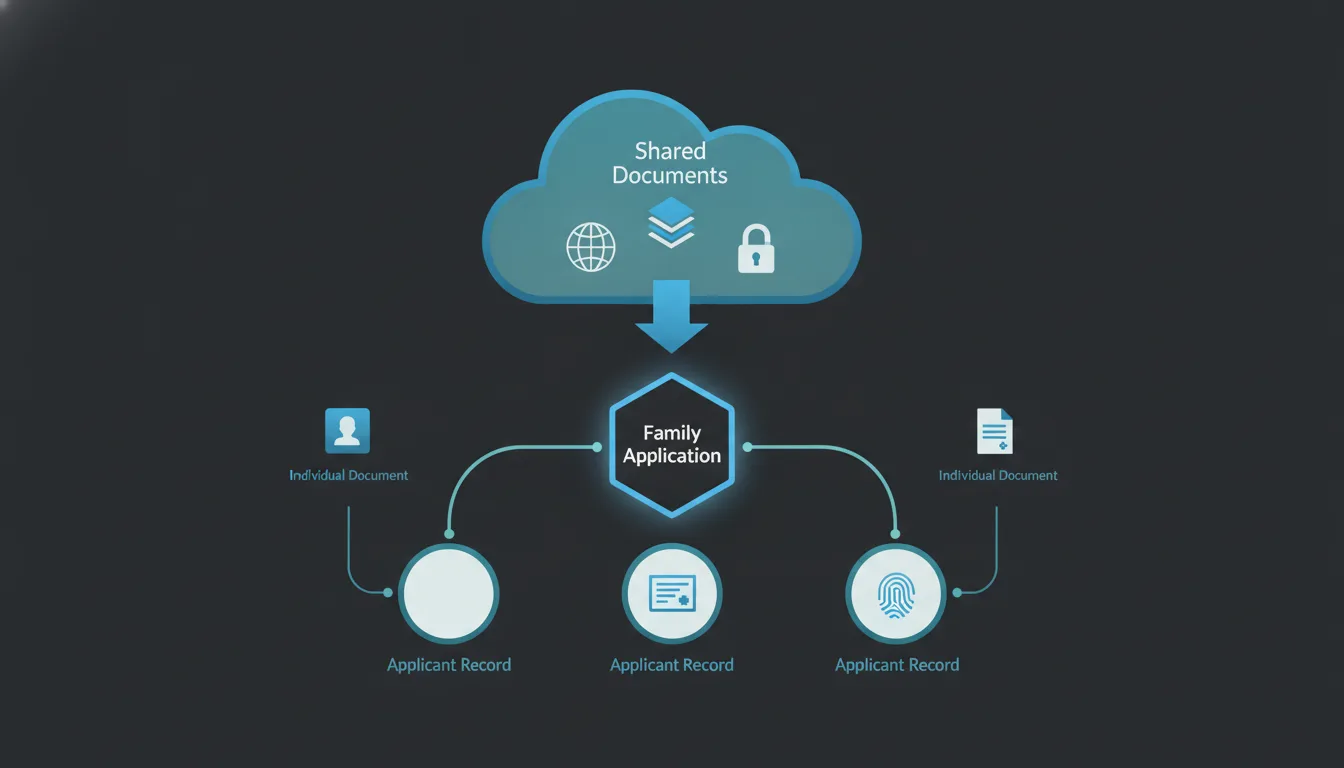
Family cases also involve several applicants. Keep one checklist per person, linked to one household, so a missing birth certificate for one child is visible without opening every file. Our guide to managing family visa applications covers that set-up, and our family visa page shows it in practice.

Tell us what you need and we'll come back with a plan. Nothing to pay until it's delivered.
Get started →A checklist that was right last year can cause a refusal this year. Official lists change without much notice. The UK visitor guide, for example, shows a last update on 25 February 2026, and it has been revised many times since it was first published in 2012. The European Commission notes that consulates may ask for more documents than its general list.
Use these habits to keep the template honest:
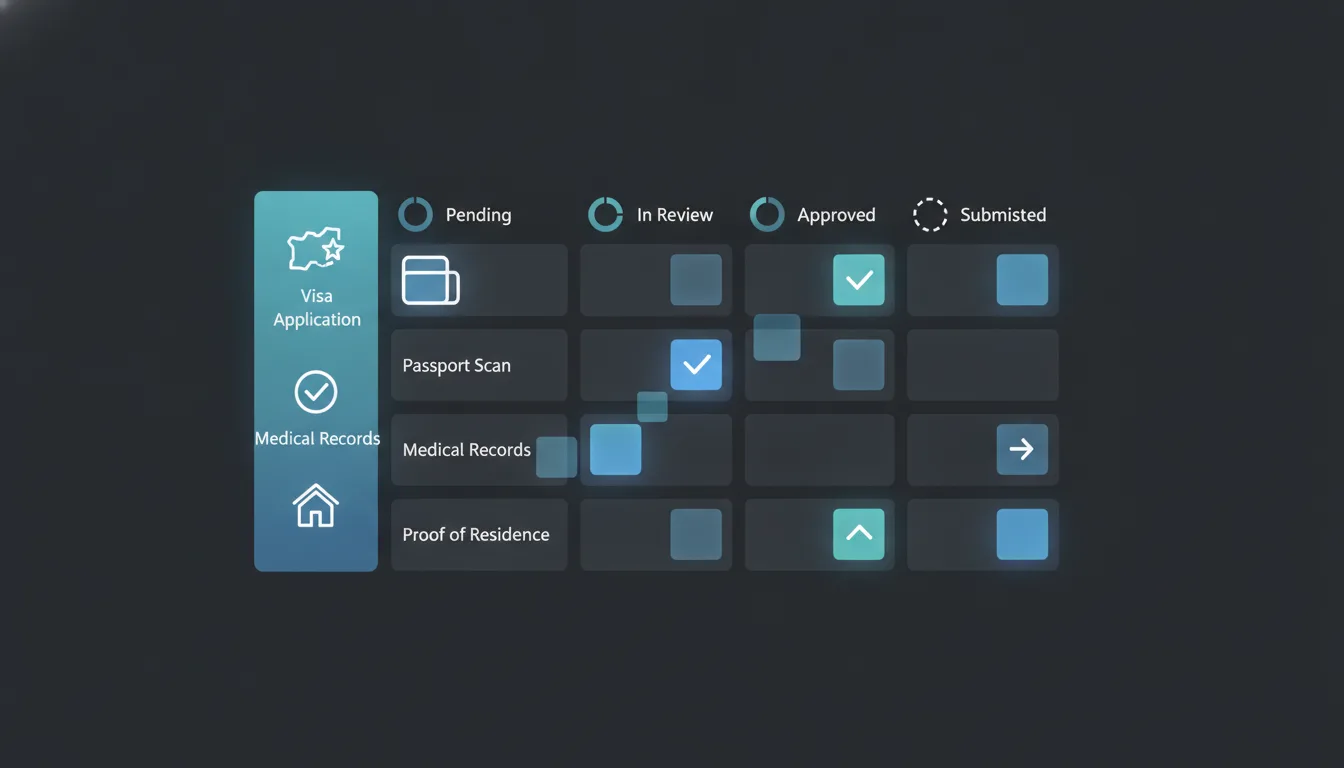
The second risk is how the checklist reaches the client. A PDF sent by email is out of date as soon as you change the template. A checklist attached to the case, where the client uploads each item and staff mark it accepted or rejected, stays current. Our guide to automating document collection explains the set-up, and document management shows how per-visa-type requirement lists work in VisaCRM.
A structured list also helps when a client has several trips. Each case gets its own checklist, even if many documents are shared. RotaVisa runs applications across more than 40 countries with a 98% approval rate, which is only possible when every destination's list is kept separately.
Finally, protect the documents you collect. Passports, bank statements and birth certificates are sensitive data. Decide who can see them and how long you keep them, as covered in our guide to client data retention.
Most applications need a valid passport, photos, the application form, proof of the purpose of the trip, proof of enough money, and proof of ties to the home country or the sponsor's status. The exact list depends on the visa type and destination. Always use the official checklist for the country and the place where the client applies, and add any documents the consulate requests.
Organise the master template by visa type, because the logic of a visitor, student, work or family case is similar across destinations. Then add a destination layer copied from the official checklist, with the source link and the date you checked it. This avoids keeping dozens of separate lists that drift apart and keeps country-specific rules in one place.
Usually, if they are not in the destination's accepted language. The rules differ. The UK, for example, requires a full translation that the Home Office can verify, with the translator's confirmation of accuracy, the date, full name, signature and contact details. Some destinations also ask for sworn or certified translations, so check the official rule for each case.
It depends on the document and the destination. Bank statements often need to be recent, and some routes set limits for other evidence. For UK partner applications, relationship evidence should be less than four years old. Put the age rule for each document into the destination layer of your checklist so staff check dates before submission, not after a refusal.
Use the destination government's immigration website, the consulate or embassy page for the place of application, or the official visa application centre. Examples are GOV.UK for UK visas and the European Commission's Schengen page, which also points to consulates for extra requirements. Save the link and the date checked in your template, and review it before each busy season.
Rules, fees and processes change. We checked this article against the official sources below on 16 September 2026 — confirm anything time-sensitive with the source before you rely on it.
The patterns in this article are already deployed across these platforms. Different brands, different visa types — one engine underneath.
Practical guides that go deeper on running a modern visa business.